

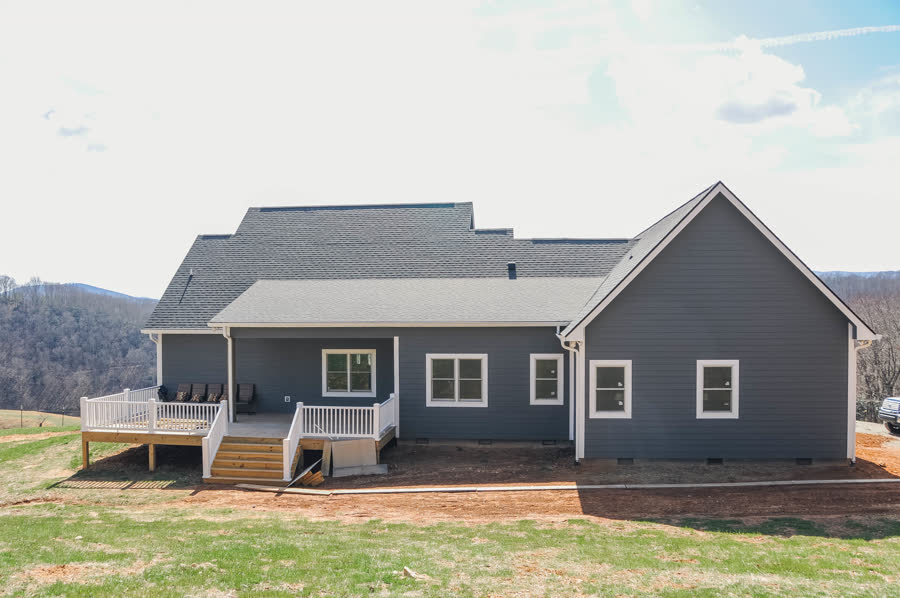
Almost every custom home we build starts the same way: someone falls in love with a piece of land. The view is extraordinary, the price seems fair, and the survey stakes are already in. What’s rarely obvious at that point is how much the land itself is going to shape the budget, the schedule, and the house that eventually sits on it.
We’d rather look at a lot with you before you close than explain a surprise after. Here’s what we’re actually walking the property looking for.
1. How you get to it
Access is the first thing and the most expensive thing to fix. A driveway that climbs a steep grade needs to be engineered, not just cut — that means switchbacks, cut-and-fill, culverts, and a surface that won’t wash out in a hard rain or turn into a sheet of ice in January.
Two questions worth answering before you sign anything:
- Can a concrete truck and a lumber delivery make it up? If they can’t, everything gets staged and shuttled, and that shows up in every line of the estimate.
- Whose road is it? A shared or private easement road means shared maintenance, and a right-of-way that reads clean on paper can still be too narrow or too steep to build against. If the driveway ties into a state road, NCDOT will need to permit that connection.
2. Whether it will perc
If there’s no public sewer — and on most of the lots we see, there isn’t — the county’s environmental health office has to issue a septic permit before the house can be permitted. That starts with a soil evaluation, and the answer is not always yes.
A lot can be beautiful and still not have enough usable soil depth for a conventional system. Sometimes the fix is an engineered system, which works but costs more. Sometimes the fix is moving the house. And sometimes the honest answer is that the lot won’t support the four-bedroom house you drew, because the septic permit sets the bedroom count.
Make your offer contingent on a passing soil evaluation. This is the single most common regret we hear.
3. Where the water comes from
Public water in the towns, wells nearly everywhere else. A well is a real line item and a real unknown — depth and yield vary a lot from ridge to hollow, and a neighbor’s good well is a hint, not a guarantee. Ask what the wells nearby had to go to, and budget honestly rather than optimistically.
4. How steep it really is
Slope drives foundation design more than any other single factor. A gentle site gets a conventional crawlspace. A steep site gets tall foundation walls, a daylight basement, drilled piers, retaining walls, or some combination — and those are all engineered elements with engineered price tags.
Steep ground isn’t a reason to walk away. Some of the best homes we’ve built are on it, because slope is what buys the view and the walk-out lower level. It just needs to be priced as what it is instead of discovered during excavation.
While you’re looking at slope, look at what’s above and below the house site. Where does water go in a downpour? Is there evidence of movement — leaning trees, slumped soil, exposed rock faces?
5. What the rules on top of it are
The North Carolina Residential Code applies everywhere, but the local layer varies a lot depending on which side of a line the parcel sits on. Depending on the property you may be dealing with county zoning, a town’s ordinances, ridge protection rules, watershed or stream buffer requirements, steep-slope provisions, or a homeowners association with its own design review.
None of these are dealbreakers by themselves. All of them are worth knowing before you own the land, because a few of them can change what you’re allowed to build — height, footprint, where the house can sit, even roof color in some HOAs.
6. Which way it faces
This one costs nothing to check and pays for itself for the life of the house. On a mountain lot, orientation decides how much winter sun you get, whether the driveway melts off or stays iced, which side takes the prevailing wind, and where the view actually is at the hours you’ll be home to see it.
Stand on the building site. In the morning and again in the late afternoon if you can. A view that’s spectacular at noon in July looks different in a gray February at four o’clock, and February is part of the deal up here.
7. What the power and internet situation is
Distance to the nearest utility pole matters, and so does whose easement the line has to cross. Running service a long way in is a cost people routinely forget to ask about until the estimate lands. Same with internet — for anyone planning to work from the house, this is worth a specific answer, not an assumption.
The short version
A lot is buildable, buildable-with-work, or a problem — and you can usually tell which within an hour of walking it with someone who builds here. What that hour saves you is the difference between a budget that holds and one that starts absorbing surprises before the footings are poured.
If you’re looking at a piece of land in Watauga, Ashe, or Avery County and want a straight answer on what it’ll take to build on it, we’re glad to walk it with you. No charge, and no obligation to build with us afterward.
More from the job site
Why a Mountain Home Isn't Just a Piedmont Home at Elevation
Wind-driven rain, ice, freeze-thaw, and snow load change how a house has to be detailed. Here's what we build differently above 3,000 feet.
Permits and Inspections in Watauga, Ashe, and Avery: How It Actually Works
The permit process isn't mysterious, but it is sequential — and one missed step stalls everything behind it. Here's the order things happen in.